The New Forest is one of the best places in the country to see an adder, which is not something most people want to hear on a summer walk. They are our only venomous snake, and on warm days they bask on paths, heathland and the sunny edges of the woodland right across the Forest. The good news is that adders are shy and would far rather avoid you. Bites are rare, and they almost always happen when a snake is trodden on or picked up.
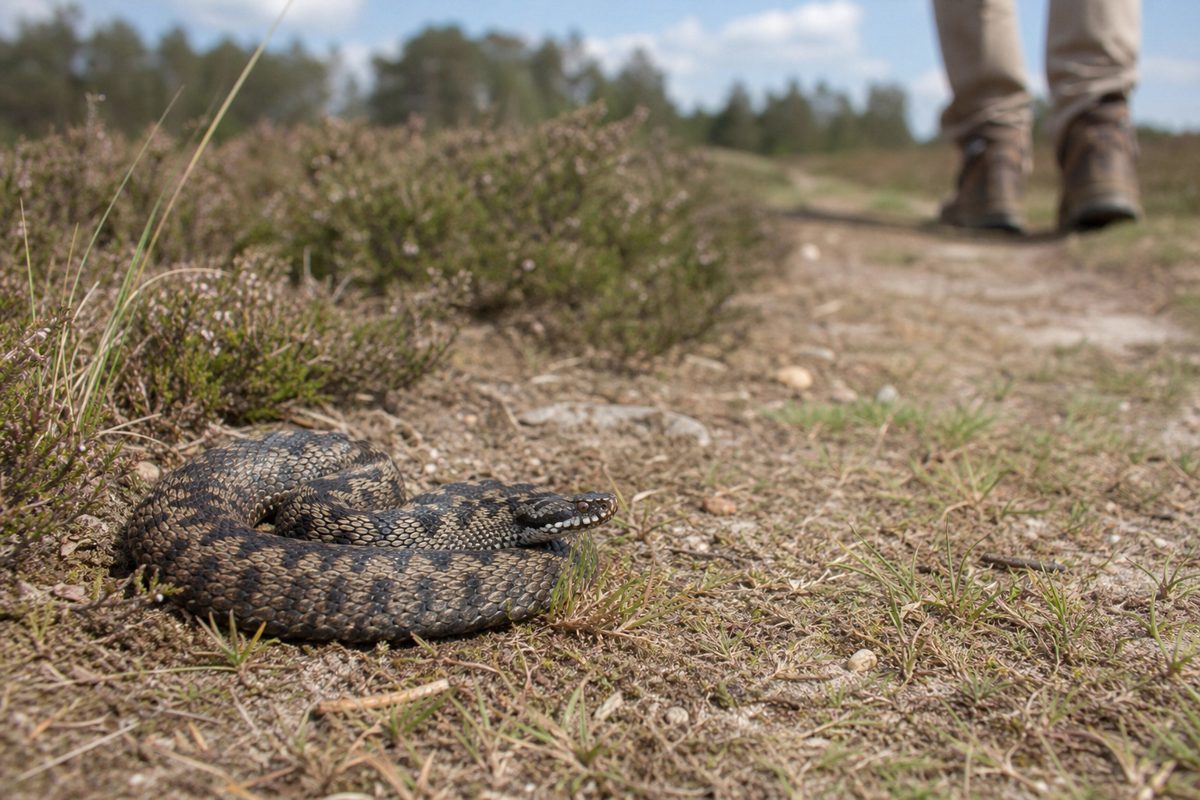
It helps to know what you are looking at. An adder is short and stocky, usually greyish or brown, with a dark zigzag running down its back and coppery eyes with a vertical pupil. If you see one, the sensible thing is to stop, keep still for a moment, then step back and go around. Give it space and it will move off. Most bites in this country happen to people who try to catch or move the snake, so the first rule is the simplest one. Leave it alone.
What an adder bite looks like
A bite usually leaves two small puncture marks, and it is painful. Over the following minutes and hours you may see swelling that spreads up the limb, along with redness and bruising, and the person may feel sick, dizzy or generally unwell. Most adder bites in the UK are not serious and people recover fully, but some cause a stronger reaction, and there is no reliable way to tell at the roadside which is which. That is why every adder bite should be seen by a medic.
What to do if someone is bitten
Keep the person calm and still. The more a bitten limb moves, the faster the venom spreads, so the aim is to keep it as quiet as possible. Sit or lie them down, keep the bitten arm or leg still, and take off any rings, watches or tight clothing near the bite before it swells. Then get medical help without delay. The advice in the UK is to go straight to A&E for any adder bite, and to call 999 if the symptoms are severe, for example difficulty breathing, swelling of the face or mouth, or the person becoming very unwell. Note the time of the bite and what the snake looked like to pass on to the medics.
What not to do
This is the part people get wrong, usually with the best of intentions. Do not try to suck out the venom, cut the wound or apply a tight tourniquet. Do not put ice on it, and do not give the person alcohol or painkillers such as ibuprofen or aspirin, which can make bleeding worse. Paracetamol is fine for pain. And do not go back for the snake. A photo from a safe distance can help the medics, chasing it cannot.
Dogs and adders
Dogs are bitten far more often than people, usually on the nose or paws from nosing through the undergrowth. If your dog is bitten, carry them rather than letting them walk where you can, keep them calm and get to a vet straight away. Adder bites in dogs can be serious, so treat them as urgent.
None of this is meant to put you off the Forest, which is a wonderful place to spend a summer. It is meant to make the point that a calm, informed response makes the difference, whether it is a snake bite, a fall or a child who has got into difficulty. That steadiness is exactly what a first aid course gives you. We run courses across the New Forest and the wider area, including outdoor first aid for people who spend their time in this kind of country. If you would like to feel ready rather than caught out, get in touch.