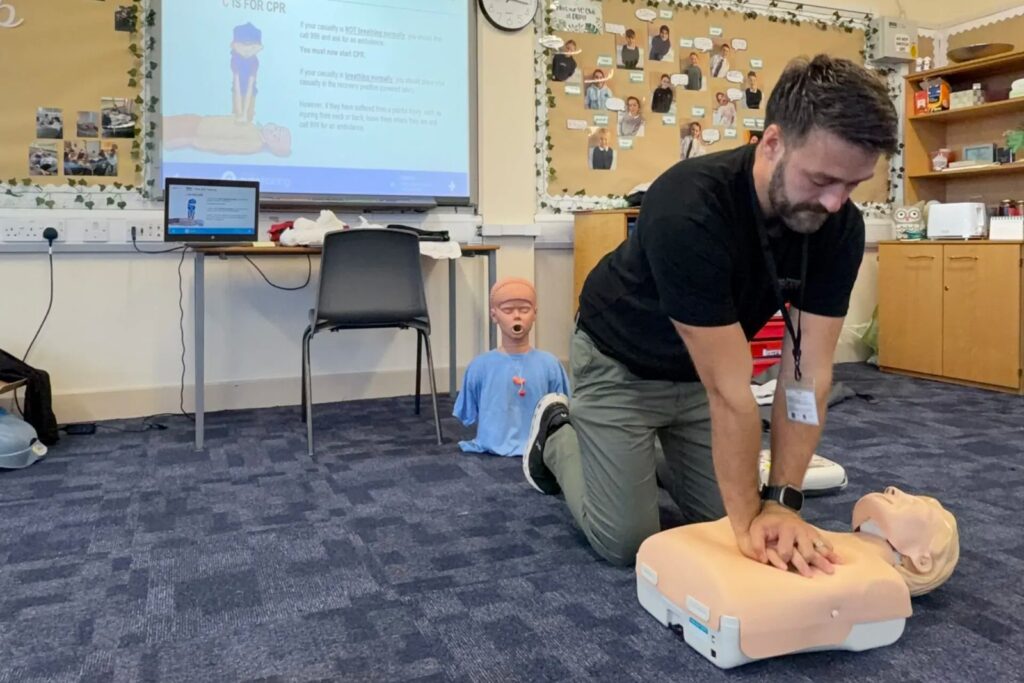
September resets every school in Hampshire, Dorset and Wiltshire. New timetables and a new intake arrive in the same week. It is also the point in the year when first aid quietly gets marked as covered, because it sits on the curriculum and there is a defibrillator on the wall near reception. Both of those things are true. Neither of them means a pupil in that school could keep someone alive on a Tuesday afternoon.
What schools are already required to do
All state funded schools in England have to teach first aid as part of statutory health education. Primary pupils cover the basics, including common injuries and how to call for help. Secondary pupils should be taught how to give CPR and what a defibrillator is for. The Department for Education’s defibrillator programme completed in 2023 and placed more than 20,000 units in almost 18,000 schools, so in most cases the equipment is already on site.
Where it comes apart
A requirement to teach something is not the same as a child leaving the room able to do it. First aid can be delivered inside twenty minutes of a PSHE lesson by a member of staff who has never knelt over a manikin. Pupils may be able to recite the steps and still stand still when it happens in front of them. What decides whether a fifteen year old starts compressions on a stranger is confidence, and confidence comes from having done it before.
What a hands on session actually changes
In a Tomorrows Lifesavers session every child gets their hands on a manikin. They feel how hard a chest compression has to be, and they practise making the call to 999 while a defibrillator talks them through the steps. Across 195 pupils at one sponsored school we measured an 82% increase in confidence. At another, 101 pupils and staff gave an 84% uplift. Those figures matter more than attendance numbers, because confidence is the part that carries out of the hall.
Who pays for it
Schools are not asked to find the money. A sponsor covers £2,000 for four classes, which is around 120 pupils, and gets back a social value report setting out what the spend returned. One sponsor’s report came in at £98,378 of social value, at roughly 29:1 SROI. The target is one million young people trained by 2035, and it only moves when a business decides a school near them is worth funding.
If your school has started the year with first aid ticked off, it may be worth asking what ticked off means in practice. And if you are looking at where a CSR budget lands this year, there is probably a year group within twenty miles of your office waiting for someone to fund them.